Bromodomain-containing proteins have been implicated in a wide variety of inflammation-related disease states, including cancer. Finding new ways to target bromodomains with novel small molecules and drugs will help pave the way for new cancer therapies and diagnostic tools.
Bromodomains are chromatin interaction domains that can control gene expression by directing assembly of transcriptional complexes on chromatin, doing so by binding acyl-lysine residues on histones and transcription factors. The importance of the normal function of these proteins is highlighted by their implication in several inflammation-related diseases, including cancer and type II diabetes.
We seek to characterize the key aspects of bromodomain protein structure and function, to develop chemical tools to study their function, and understand their roles in a cellular context. To do this, we use a wide variety of techniques such as protein-detected Nuclear Magnetic Resonance (NMR) spectroscopy, structure-activity relationship (SAR), organic synthesis, Isothermal Titration Calorimetry (ITC), x-ray crystallography, alpha screen, and cellular assays.
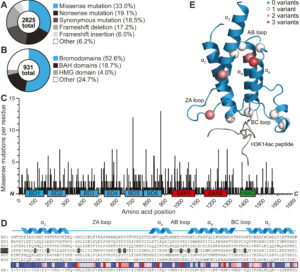
CANCER-ASSOCIATED PBRM1 MISSENSE VARIANTS
The PBRM1 protein, a key component of the PBAF chromatin remodeling complex, contains six bromodomains that recognize acetylated lysine residues on histones, linking epigenetic modifications to gene regulation and chromatin accessibility. As a tumor suppressor, PBRM1 is frequently mutated in cancers, especially clear cell renal cell carcinoma (ccRCC). There, many mutations cluster in its bromodomain, particularly the fourth (BD4). While many mutations cause complete loss of PBRM1 expression, about 15% are missense mutations that result in full-length proteins with potentially altered function. In Bursch et al (2024), we used computational, biophysical, and cellular methods to analyze 16 cancer-associated BD4 missense variants. PBRM1 mutations differentially affect protein stability, binding to acetylated histones, and tumor suppressor functions. These findings underscore the functional diversity of PBRM1 mutations and their potential impact on cancer progression and response to therapies like immune checkpoint blockade, highlighting the need for deeper characterization to inform precision medicine strategies.
TRIM33 IS A NOVEL EPIGENETIC READER OF LYSINE LACTYLATION
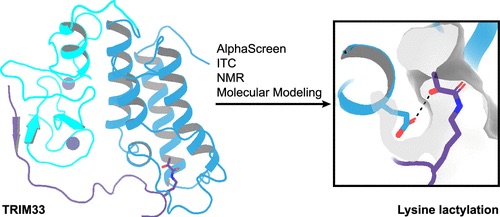
Macrophages may regulate inflammation through lysine lactylation (Kla), a novel histone modification. Lysine lactylation arises from the metabolic byproduct lactate and builds up in inflammatory (M1) macrophages during the later stages of their activation. It also may help silence inflammation-promoting genes. The Smith Lab screened bromodomain-containing proteins, which are typically known for binding lysine acetylation, for Kla binding (Nuñez et al, 2024). TRIM33 was the only protein identified in this screen with a binding affinity for Kla, an interaction confirmed in a cellular context by immunoprecipitation. These findings reveal TRIM33 as the first known bromodomain-containing "reader" of histone Kla, shedding light on how metabolism can influence gene regulation during inflammation and offering new potential targets for treating inflammatory diseases.
STRUCTURE-INFORMED BROMODOMAIN STUDIES
Despite clear implications in numerous inflammation-related diseases, such as cancer, diabetes, and heart disease, much remains unknown regarding bromodomain structure, function, and potential drug targets. We approach these unknowns using methodology developed in the MCW Program in Chemical Biology and Mellowes Center Structural Genomics Unit. We develop novel inhibitors and chemical probes, and investigate disease-associated mutations.
SELECTIVE TARGETING of PBRM1
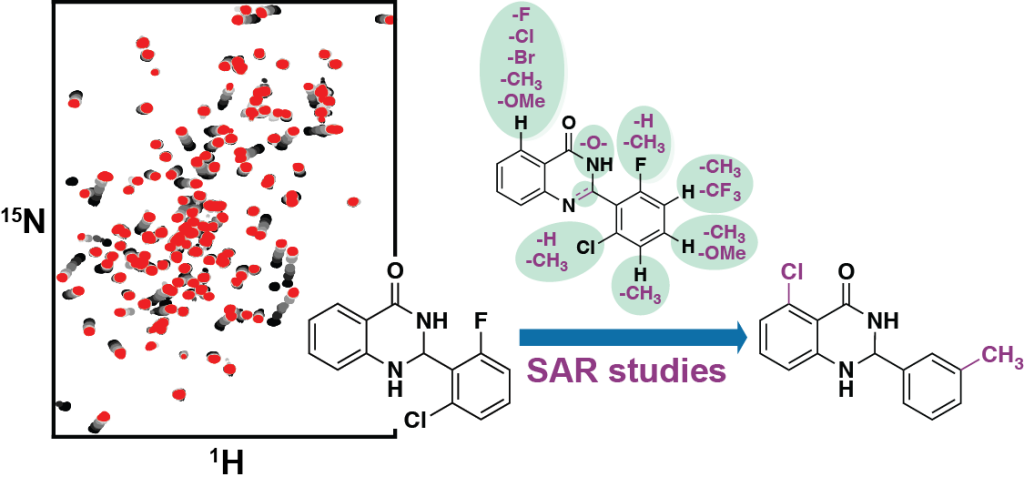
Focusing on the Polybromo-1 (PBRM1) protein, which is implicated in cancer, we noted that no selective inhibitors yet existed to target individual bromodomains. Of the six connected bromodomains, we developed a selective inhibitor for the second (BD2) (Shishodia et al, 2022). This was done using our innovative NMR fragment screening pipeline (Egner, 2017, Kerber et al, 2023) coupled with functional studies. This represents a major advance in studying this protein implicated in cancer, as it is the first selective inhibitor for any of the PBRM1 bromodomains.
TARGETING BRD4 by COVALENT MODIFICATION
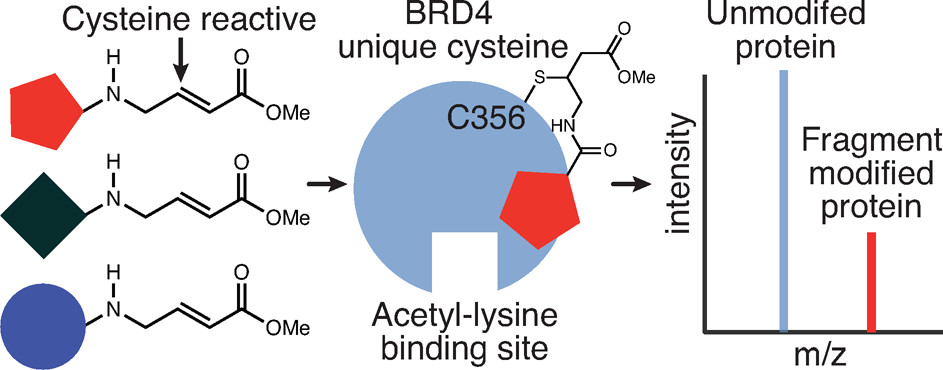
BRD4, a BET family bromodomain protein containing two bromodomains, is a promising target for cancer and other inflammation-related diseases. However, selective inhibitors and probes remain elusive. We screened a cysteine-reactive drug fragment library against BRD4 and found binding to a unique cysteine on the second bromomdomain of BRD4. Coupling this fragment to the pan-BET inhibitor JQ1 allowed for covalent and selective modification of BRD4 (Olp et al, 2020).
BROMODOMAIN "READERS" of DISTINCT ACYLATIONS
Bromodomain proteins are known as epigenetic "readers," and their role in binding to acetylated lysine residues on histone proteins is well-described. However, since 1963, when lysine acetylation was first described, numerous distinct acylation marks on lysines have been recently discovered. Levels of different acylated-CoA species can be linked to the metabolome, thus posing a potential link between metabolism and regulation of transcription by bromodomain binding. We seek to understand the significance of bromodomain protein interactions with the broad range of acylations and the downstream effects on transcriptional regulation.
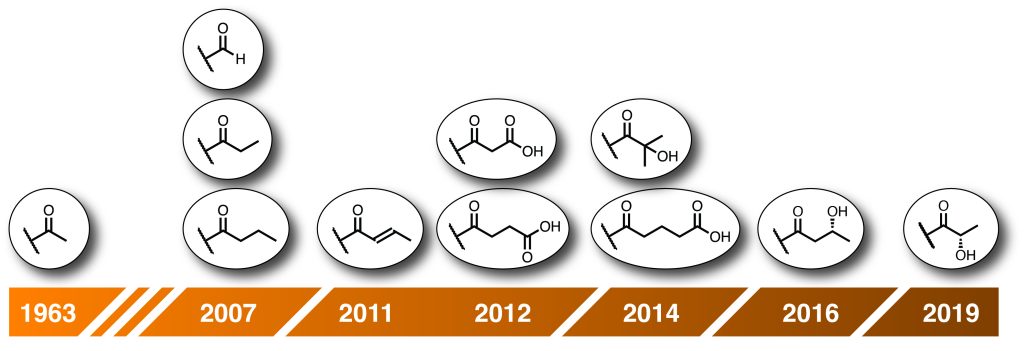
MULTIPLE ACYLATIONS TUNE HISTONE H4 BINDING TO BRD4
We investigated whether BET family bromodomain proteins (BRD2, BRD3, BRD4, and BRDT) could interact with metabolically-derived lysine acylations (Olp et al, 2017). In N-terminal BET bromodomains (BD1) bound acetylated and propionylated peptides; all other acylations inhibited binding. This suggests the levels of acylated-CoA tune or block recruitment of BET bromodomains to histones, linking metabolism to transcription.

SELECTED REFERENCES
Bursch KL, Jorge SD, Catlin AE, Nunez R, LeClaire MD, Licklider J, Urrutia R, and Smith BC. Structural Genomics Defines PBRM1 Bromodomain Variant Function in ccRCC. Human Mutation (2026). 10.1/humu/924621. PMID: 42559237. PMCID: PMC13439403.
Nuñez R, Sidlowski PFW, Steen EA, Wynia-Smith SL, Sprague DJ, Keyes RF, Smith BC. The TRIM33 Bromodomain Recognizes Histone Lysine Lactylation. ACS Chemical Biology (2024). doi: 10.1021/acschembio.4c00248. PMID: 39556662.
Bursch KL, Goetz CJ, Jiao G, Nuñez R, Olp MD, Dhiman A, Khurana M, Zimmermann MT, Urrutia RA, Dykhuizen EC, Smith BC. Cancer-associated Polybromo-1 bromodomain 4 missense variants variably impact bromodomain ligand binding and cell growth suppression. Journal of Biological Chemistry (2024). doi: 10.1016/j.jbc.2024.107146. PMID: 38460939.
Kerber PJ, Nuñez R, Jensen DR, Zhou AL, Peterson FC, Hill RB, Volkman BF, Smith BC. Fragment-based screening by protein-detected NMR spectroscopy Methods in Enzymology (2023). doi: 10.1016/bs.mie.2023.06.018. PMID: 37858532.
Shishodia S, Nunez R, Stormier BP, Bursch KL, Goetz CJ, Olp MD, Jensen DR, Fenske TG, Ordonez-Rubiano SC, Blau ME, Roach MK, Peterson FC, Volkman BF, Dykhuizen EC, Smith BC. Selective and Cell-Active PBRM1 Bromodomain Inhibitors Discovered through NMR Fragment Screening. Journal of Medicinal Chemistry. 2022 October. doi: 10.1021/acs.jmedchem.2c00864
Olp MD, Cui H, Pomerantz WC, Smith BC. "Pharmacological Regulation and Functional Significance of Chromatin Binding by BET Tandem Bromodomains." In: Protein-Protein Interaction Regulators. Roy S, Fu H, editors. Cambridge, UK: Royal Society of Chemistry; 2021. Chapter 9; p.209-248.
Olp MD, Sprague DJ, Goetz CJ, Kathman SG, Wynia-Smith SL, Shishodia S, Summers SB, Xu Z, Statsyuk AV, Smith BC. “Covalent-Fragment Screening of BRD4 Identifies a Ligandable Site Orthogonal to the Acetyl-Lysine Binding Sites.” ACS Chemical Biology. 2020 March 23. PMID 32149490
Fahey JM, Stancill JS, Smith BC, Girotti AW. “Antagonistic effects of nitric oxide in a glioblastoma photodynamic therapy model: mitigation by BET bromodomain inhibitor JQ1”. Journal of Biological Chemistry. 2018, 293, 5345-59.
Egner JM, Jensen DR, Olp MD, Kennedy NW, Volkman BF, Peterson FC, Smith BC, Hill RB. “Development and Validation of 2D Difference Intensity Analysis for Chemical Library Screening by Protein-Detected NMR Spectroscopy”. ChemBioChem. 2017, 19, 448-58. Appeared as the Cover Article
